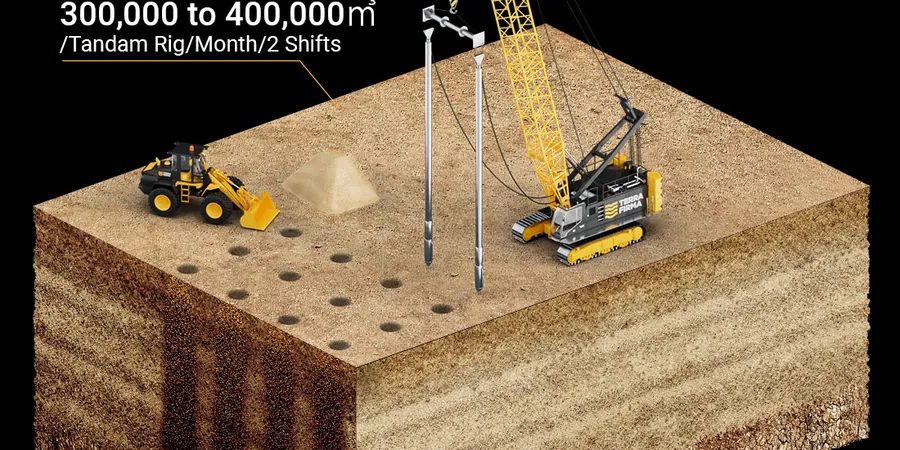
The vibrator itself is a beast of a tool—a long steel lance housing an eccentric weight spinning at 1800 to 2000 rpm, suspended from a crawler crane. When we deploy it in Palmerston North, the machine gets put to work on the loose alluvial sands and silts that define the Manawatu River floodplain; the city sits on some of the most compaction-friendly geology in the lower North Island, but only if the design accounts for the thin interbedded organic layers that can swallow vibration energy. At our Palmerston North projects we typically pair the vibroflot with a water-jetting system to help the probe reach design depth through the silty overburden common in areas like Milson and Roslyn. The real art is in the spacing grid and dwell time—parameters we tune after reviewing CPT logs and grain-size curves, because every block of land between the Tararua foothills and the river has its own depositional story.
Vibrocompaction works brilliantly in the Manawatu floodplain sands—until you hit a silty pocket the grid did not plan for.
Technical details of the service in Palmerston North
Critical ground factors in Palmerston North
Palmerston North grew fast after the railway arrived in 1891, and a lot of the early industrial land was sited on cheap floodplain sections nobody wanted to farm. That legacy means today's redevelopment projects—think warehouse extensions in Mangaone or apartment blocks near Massey University—often sit on fill over natural loose sands, with the water table barely three metres down. A vibrocompaction design that ignores the seismic component is a liability: the city is only about 150 km from the Hikurangi subduction zone, and the 2016 Kaikoura quake gave Manawatu a reminder that long-period shaking travels well through soft ground. Liquefaction-induced settlement under a shallow footing can easily exceed 200 mm if the upper 10 metres of sand are not densified, turning a serviceable warehouse slab into a cracked mess after one moderate event. We run Seed-Idriss-based liquefaction checks on every compaction layout, adjusting the treatment depth until the factor of safety against triggering stays above 1.2 for the design earthquake.
Our services
A vibrocompaction job in Palmerston North is never just a matter of showing up with a vibroflot. The design phase pulls together several investigation threads to make sure the ground responds the way the model predicts.
CPT-based compaction design
Cone penetration testing across the site to map tip resistance and friction ratio before design, giving us the baseline for grid spacing and energy input per probe location.
Grain-size and fines screening
Sieve and hydrometer analyses from wash-bored samples to flag silt lenses that would defeat pure vibrocompaction and trigger a hybrid design approach.
Pre- and post-treatment verification
Repeat CPT traverses on a 5–10 m staggered grid after compaction, comparing cone resistance gains against the NZGS acceptance criteria specified in the design brief.
Liquefaction mitigation reporting
Full design statement with Seed-Idriss triggering curves, settlement estimates, and a signed PS1 producer statement for building consent submission to Palmerston North City Council.
Frequently asked questions
How much does a vibrocompaction design package cost for a typical Palmerston North site?
For a standard industrial or commercial lot in Palmerston North—say 1,500 to 4,000 square metres—a full design package including CPT investigation, lab fines testing, compaction layout drawings, and a producer statement generally runs between NZ$2,140 and NZ$9,560 depending on the number of probe points, depth of treatment, and whether hybrid elements like stone columns are needed at the margins. Multi-storey residential or large-format retail jobs with tighter seismic performance targets sit at the upper end.
At what depth does vibrocompaction stop being effective in the Manawatu soils?
In the alluvial sands typical of Palmerston North, a 130–180 kW vibroflot reliably densifies down to about 30–35 metres below the working platform, provided the probe can penetrate without obstruction. Below that depth the confining stress is high enough that natural density is often already acceptable, and the added cost of deeper treatment rarely improves the liquefaction safety case. The practical limit is usually set by the depth of the loose layer identified in the CPT profile rather than by the equipment itself.
Does the Palmerston North City Council accept vibrocompaction as a ground improvement method for building consent?
Yes—Palmerston North City Council accepts vibrocompaction as a recognised ground improvement technique under the NZ Building Code, provided the design is supported by a producer statement (PS1) from a chartered geotechnical engineer. The council's consent team will want to see pre- and post-treatment CPT data, a liquefaction assessment aligned with NZGS Module 1, and settlement calculations demonstrating compliance with the serviceability limit state for the proposed structure. More info.