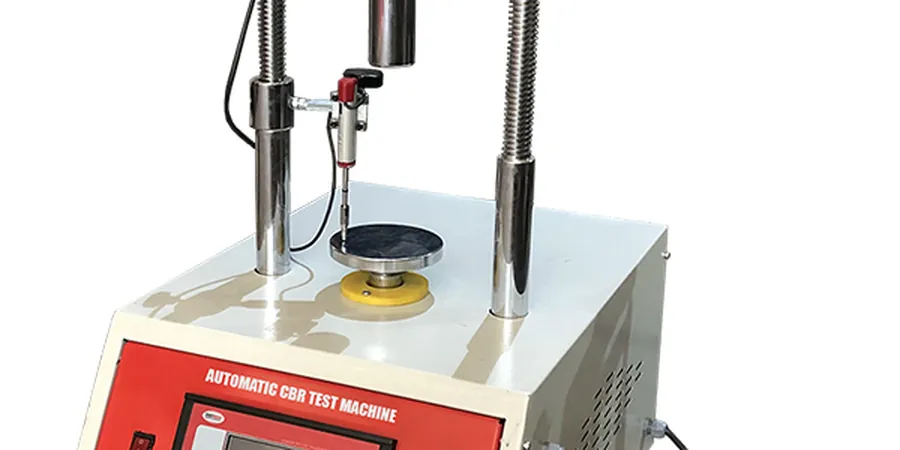
Palmerston North sits on the Manawatu River floodplain, where Quaternary alluvium and volcanic loess deposits create highly variable subgrade conditions. With an average annual rainfall of 970 mm and a water table that fluctuates seasonally, even well-graded basecourse can fail if the formation layer loses strength after wetting. That is why the laboratory CBR test remains the most specified parameter in NZS 3404 pavement design across the region. Whether the job involves a new cul-de-sac in Kelvin Grove, a car park extension at Massey University, or a rural road upgrade near Ashhurst, the soaked CBR value determines the required pavement depth. We run the test at our Palmerston North lab using standard compaction energy and four-day soak, then report the result alongside the swell percentage. For projects where in-situ density control is also needed, we pair this with sand cone density testing on the compacted fill.
A soaked CBR of 3 versus 8 can double the required aggregate thickness — that single number drives the earthworks budget on every road job in the Manawatu.
Technical details of the service in Palmerston North
Critical ground factors in Palmerston North
The biggest threat to pavement performance in Palmerston North is not heavy traffic — it is moisture sensitivity of the subgrade. The loess-derived silts that blanket much of the city lose significant bearing capacity when saturated, with unsoaked CBR values sometimes dropping 60–70 % after four days of soaking. A client who only tests the material at natural moisture content gets a misleadingly optimistic number and risks under-designing the pavement. The council's Infrastructure Development Code explicitly requires soaked CBR values for all new roading and commercial subdivisions. Skipping this step has led to premature rutting on collector roads in Hokowhitu and edge cracking on shared paths along the river corridor. The laboratory CBR test is the cheapest insurance against those failures — a $250 test that can prevent a $50,000 pavement reconstruction five years later.
Our services
The Palmerston North lab runs CBR testing three days a week, with standard turnaround of five working days. For urgent programming we offer three-day express results. Every test includes the full swell curve graph.
Soaked CBR at Standard Compactive Effort
One-point compaction at optimum moisture content, four-day soak under surcharge, and penetration test. This is the default method for subdivision roads, car parks, and any pavement where the subgrade may become saturated during its service life.
CBR with Moisture-Density Relationship
Three-point compaction curve plus CBR at each moisture content. This package is recommended when the earthworks specification requires a target density range and the designer needs to know how CBR varies with placement moisture. Common for airport pavements and heavy-duty industrial yards.
Frequently asked questions
What does a laboratory CBR test cost in Palmerston North?
A standard soaked CBR test costs between NZ$200 and NZ$390, depending whether you need a one-point test or the full moisture-density relationship with three compaction points. The lab can confirm the exact price once we know your material type and the number of samples.
How long does it take to get the CBR result?
Five working days from sample drop-off. The four-day soak drives the timeline. We can provide unsoaked CBR in two days if you only need a preliminary number for earthworks control, but the council will always require the soaked value for final pavement design sign-off.
What size sample do I need to bring to the lab?
Bring at least 25 kg of disturbed material in a sealed bag or bucket. The sample must be representative of the subgrade layer you intend to test — avoid the topsoil and any organic matter. If you are sampling from a test pit, take material from the formation level, not the sidewalls.
When can I use an unsoaked CBR instead of soaked?
Unsoaked CBR is only acceptable for pavements where the subgrade will never become saturated — for example, an enclosed warehouse slab with a damp-proof membrane and perimeter drainage that guarantees the water table stays well below formation. For all exterior roads, car parks, and footpaths in Palmerston North, the council's code requires soaked CBR.