Too many concrete pavements in Palmerston North fail early—not because the mix was wrong, but because the ground underneath couldn't handle it. We see curling slabs at the joints, transverse cracks appearing before the first heavy truck rolls through, and pumping of fine Manawatu silts up through contraction joints after a wet winter. The real problem is almost never the concrete itself. It is the subgrade support, the drainage layer, and the joint spacing calculated for Auckland conditions instead of local Manawatu climate. Rigid pavement design here needs to account for the high seasonal groundwater that sits just 1.5 to 2 meters below large parts of the city, the shrink-swell potential of the Kairanga clay loams, and the 1,200 mm of annual rainfall that keeps the basecourse saturated for months. When we design a rigid pavement for an industrial yard or a dairy tanker access road in this region, we start with the CBR testing data and work upward—never the other way around. A slab is only as good as the layers beneath it.
Concrete curling in Manawatu is a climate problem, not a mix design problem—joint spacing must match Palmerston North's humidity range, not Auckland's.
Technical details of the service in Palmerston North
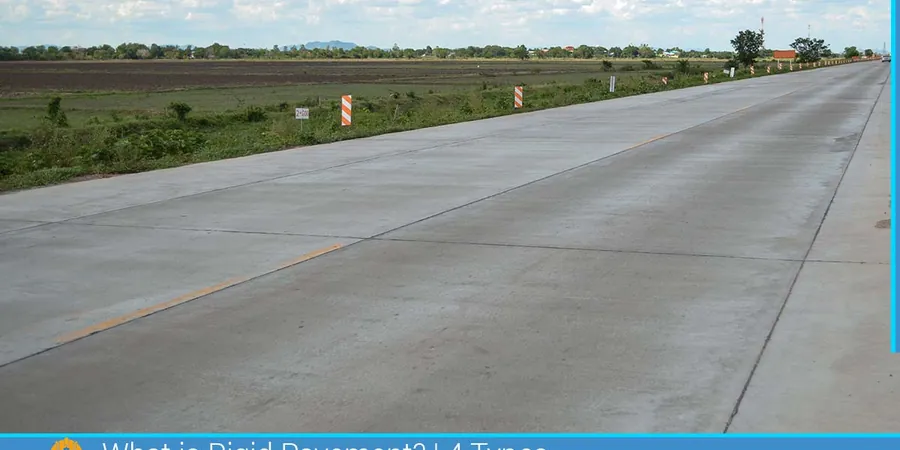
Critical ground factors in Palmerston North
Palmerston North sits on the floodplain of the Manawatu River, and that fact alone defines the risk profile for any rigid pavement. The difference between summer and winter here is extreme: bone-dry February ground shrinks and opens up voids under the slab edges, while July rain saturates the upper subgrade and turns it into a pumpable slurry. Every heavy vehicle axle then acts like a piston, ejecting fines through the joints and progressively hollowing out the slab corners. Add to this the city's average of 113 wet days per year, and you have a near-constant cycle of saturation, loading, and erosion. Our rigid pavement designs interrupt this cycle at three points: a properly graded open-graded drainage layer, load-transfer efficiency at every contraction joint via dowel baskets sized per NZS 3101, and subgrade treatment depths calculated from soaked CBR values—not optimum moisture values that look great in the lab but never exist in the field. For dairy sheds and tanker hardstands on the outskirts toward Bunnythorpe, we also factor in the aggressive lactic acid runoff that attacks standard concrete if the mix isn't specified correctly.
Our services
Our rigid pavement design work covers the full chain from subgrade investigation through to construction specification and joint detailing. Everything is calibrated to the Manawatu ground conditions.
Full-depth rigid pavement design for industrial and commercial sites
Concrete thickness design, joint layout and detailing, reinforcement specification (steel fibre or mesh), drainage layer design, and construction QA/QC protocols. All designs include a subgrade treatment specification based on soaked CBR and in-situ k-value testing, not desktop assumptions. Suitable for distribution centres, tanker hardstands, truck docks, and food-processing yards in the Palmerston North area.
Forensic investigation and rehabilitation of failed rigid pavements
Pumping investigation, slab deflection testing, joint load-transfer efficiency measurement, and subgrade void detection using ground-penetrating radar. We determine whether the failure mechanism is subgrade-related, joint-related, or mix-related, and provide a rehabilitation design that addresses the root cause—not just a resurfacing that will fail again in two winters.
Frequently asked questions
Why do concrete slabs curl at the joints in Palmerston North more than in other regions?
The Manawatu climate has wide diurnal temperature swings and sustained high humidity. A concrete slab dries from the top down, creating a moisture gradient that causes the top to shrink relative to the bottom. In Palmerston North, the average annual relative humidity hovers around 80%, so the bottom of the slab stays wet while the top dries—this differential is larger than in drier regions like Canterbury. The result is upward curling at the joints and corners. Our designs reduce joint spacing by 10–15% compared to standard NZS 3404 maximums to keep curling stresses within acceptable limits, and we specify curing regimes that slow down surface drying in the first 72 hours.
How much does a rigid pavement design cost for a typical industrial site in Palmerston North?
Design fees for rigid pavements in the Palmerston North region typically range from NZ$3,360 to NZ$9,810 depending on the site area, traffic loading complexity, and the number of geotechnical investigation points required. A small tanker hardstand with one borehole and CBR testing sits at the lower end; a full distribution centre with plate load tests, multiple pavement zones, and detailed jointing plans sits toward the upper end. We provide a fixed-fee proposal after an initial site walkover.
What is the difference between rigid and flexible pavement in terms of how they handle Manawatu soils?
Flexible pavement distributes load through a layered system and tolerates some subgrade deformation—it bends. Rigid pavement spans small subgrade weaknesses due to its high flexural stiffness. On the soft, moisture-sensitive silts of the Manawatu floodplain, rigid pavement is often preferred for heavily loaded areas because it bridges localised soft spots that would cause rutting in asphalt. However, it is far less forgiving of poor joint detailing and drainage. If water gets trapped under a rigid slab, pumping destroys the subgrade support rapidly. The choice between the two depends on loading type, maintenance tolerance, and groundwater conditions at the specific site.
How long does a properly designed rigid pavement last in the Manawatu region?
A rigid pavement designed to NZS 3404 with correct subgrade treatment, jointing, and drainage should achieve a 40-to-50-year structural life for industrial applications, assuming normal maintenance of joint sealants every 7 to 10 years. The main threats to longevity in Palmerston North are subgrade pumping from poor drainage and joint spalling from overloaded forklift traffic. Both are preventable through design—the drainage layer specification and the joint detailing are what separate a pavement that lasts 15 years from one that lasts 40.