One of the most common callouts we get in Palmerston North comes after a council inspection flags inconsistent compaction results. A contractor will have laid and rolled a structural fill lift, confident in the roller passes, only to have the sand cone test reveal dry density well below the specified 95% or 98% of maximum dry density. The culprit is almost always moisture conditioning. The Manawatu’s loessial soils and volcanic ash-derived silts are highly moisture-sensitive; a lift that looks firm on the surface can be drying out faster than expected in the Rangitikei wind, or conversely, holding too much water after a sudden downpour on the flats near Fitzherbert Avenue. We run the field density test in Palmerston North using the sand cone method to give you a direct, verifiable number—not a proxy reading from a nuclear gauge that needs recalibration for local mineralogy. Before placing the next lift, it pays to confirm the reference curve with a Proctor test matched to the exact borrow source, because maximum dry density can shift noticeably between pits just a few kilometres apart around Linton or Bunnythorpe.
In the Manawatu’s moisture-sensitive silts, a sand cone test is the only way to get a direct density value that a council inspector can’t dispute.
Technical details of the service in Palmerston North
Critical ground factors in Palmerston North
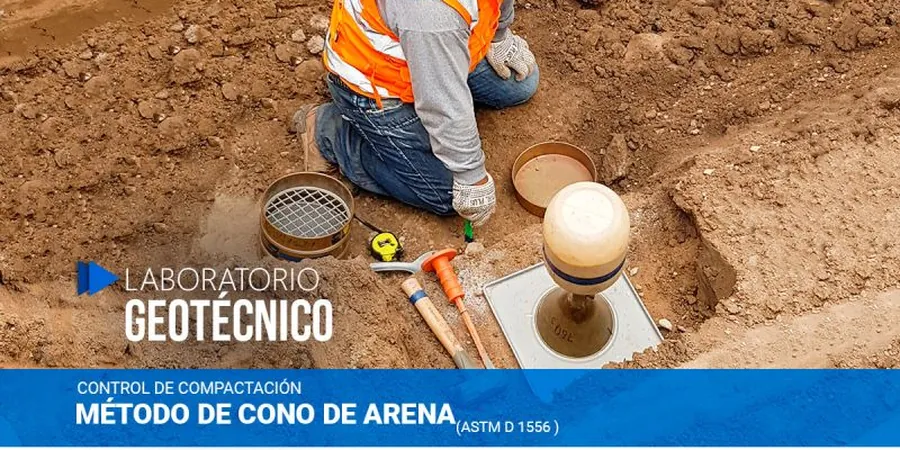
The sand cone density kit we carry around Palmerston North is deceptively simple—a one-gallon plastic jar, a metal cone with a valve, and a base plate with a 165 mm opening. But that simplicity means every source of error falls on the operator. The most serious failure mode we encounter is sand loss into a coarse subgrade. When compacting a granular Taranaki-sourced basecourse over an open-graded drainage layer north of the railway line in Milson, an unsealed test hole lets the Ottawa sand drain away, giving a falsely large volume and an erroneously low density. We seal the hole bottom with a thin layer of quick-setting plaster or use a latex membrane when the spec allows. The second risk is testing on a lift that is too thin for the aggregate size—the rule of thumb is a minimum lift thickness of four times the maximum particle size, or the sand cone hole will hit the underlying layer and mix materials. In the Terrace End area, where older fills often contain bricks and demolition debris, we sometimes need to combine the density test with a test pit investigation to verify the fill composition before accepting a compaction result.
Our services
Our Palmerston North lab provides the sand cone density service as part of a complete compaction-control package. Every test includes oven moisture content, density calculation, and a report comparing the result to the specified target value from the reference Proctor curve.
Compaction verification for building platforms
Sand cone testing on residential and commercial slab subgrades, carried out at the frequency required by the Palmerston North City Council consent conditions. We test each lift of engineered fill and provide a signed density report within 24 hours.
Roading and pavement density control
In-situ density measurement on subgrade, sub-base, and basecourse layers for road reconstruction projects. We work to NZTA M/3 and M/4 specifications and can test modified Proctor compacted materials where higher energy compaction is required.
Trench reinstatement testing
Density verification on utility trench backfill across Palmerston North’s network of water, gas, and fibre corridors. We match the reference Proctor to the imported fill source and test at depth intervals to confirm uniform compaction.
Frequently asked questions
How much does a sand cone density test cost in Palmerston North?
For work within the Palmerston North urban area, a single sand cone field density test typically costs between $190 and $240 plus GST, including the technician’s travel time, the calibrated sand, and the laboratory moisture content determination. The total cost depends on the number of tests per site visit and the travel distance: a site near Kelvin Grove with five or six tests will be more economical per test than a single test out toward Ashhurst. We always provide a firm quote before mobilising.
What is the difference between the sand cone test and a nuclear density gauge?
The sand cone method measures density directly by excavating a known volume of soil and weighing it, so there is no calibration curve that can drift. A nuclear gauge measures density indirectly by counting backscattered or transmitted gamma radiation, and it must be calibrated against a sand cone measurement on the same material to be reliable. In Palmerston North’s loess-derived silts, which contain variable amounts of iron oxide nodules, nuclear gauge readings can shift by several percent if the calibration isn’t site-specific. The sand cone is slower but it’s the referee method—if there’s ever a dispute with the council, the sand cone result is the one they accept.
How many tests do I need for a residential foundation in Palmerston North?
The Palmerston North City Council typically requires one field density test per 500 square metres per compacted lift for engineered fill under a building platform. For a standard 200-square-metre house slab on a 300 mm thick compacted fill, that usually means one test on the single lift. If the fill is placed in two 150 mm lifts, you would need one test per lift. We recommend checking your resource consent conditions, as some subdivisions in zones with known liquefaction susceptibility around the Hokowhitu Lagoon area may have tighter testing frequencies specified.