In Palmerston North, seismic considerations are shaped by the city’s position within the actively deforming North Island, where the nearby Wellington-Mohaka Fault System and deep alluvial deposits of the Manawatū Basin introduce distinct ground-shaking and site-response challenges. Our work under this category addresses these conditions through targeted assessment and design aligned with the New Zealand Building Code’s seismic performance requirements, including NZS 1170.5. We commonly integrate seismic microzonation to map variable ground behaviour across the urban area and soil liquefaction analysis to evaluate the loose, saturated sediments prevalent along the Manawatū River corridor.
These services support mid-rise commercial structures, lifeline infrastructure, and industrial facilities where tolerable risk thresholds demand refined ground-motion inputs. For projects requiring enhanced resilience beyond conventional ductile detailing, we couple site-specific response studies with base isolation seismic design to decouple superstructures from damaging ground movement. The result is a defensible, code-compliant seismic package that accounts for Palmerston North’s basin-edge amplification and cyclic softening hazards without over-conservatism.
Anchor bond stress in the Manawatu gravels can exceed 400 kPa, but only when grout injection pressure and mix design are matched to the site's permeability profile.
Technical details of the service in Palmerston North
Critical ground factors in Palmerston North
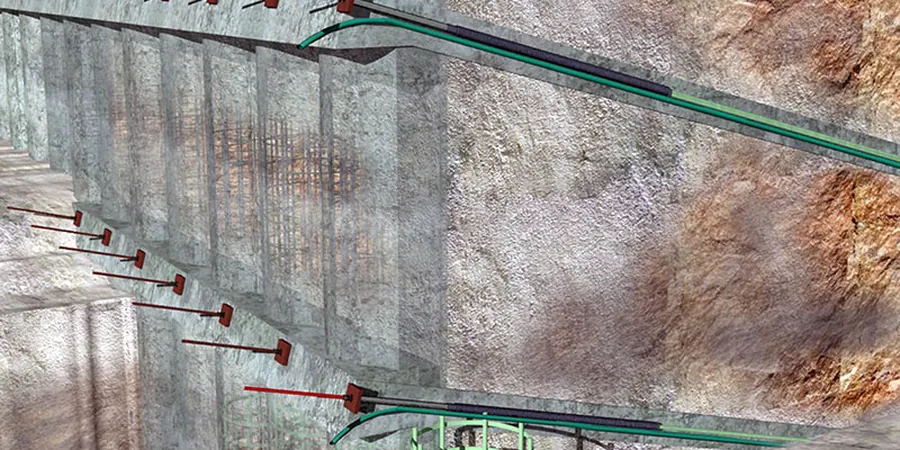
Palmerston North sits on deep alluvial deposits that have a well-documented history of amplification during seismic events, and the GNS Science seismic hazard model assigns the city a Peak Ground Acceleration of approximately 0.35g for a 500-year return period. A retaining wall anchored in these soils must survive not just the static earth pressures but also the dynamic loads induced during a significant earthquake. The risk of a progressive anchor failure is real if the bond zone extends into liquefiable silts, which are mapped extensively across the Hokowhitu and Awapuni areas. We address this by running post-liquefaction residual strength checks on every anchor, and where necessary we extend the bond zone deeper into non-liquefiable gravels. Ignoring this step can lead to a sudden loss of pre-stress and catastrophic wall movement, a failure mode that is entirely preventable with proper liquefaction assessment integrated into the anchor design workflow.
Our services
Our anchor design package covers the full project cycle, from feasibility to lock-off and long-term monitoring.
Temporary Shoring Anchors
Design of active strand anchors for sheet pile and soldier pile walls during deep excavations, including staged stressing sequences to control wall deflection in real time.
Permanent Tied-Back Walls
Full Class I double-corrosion-protected anchor systems for basement walls and bridge abutments, with 100-year design life and integrated monitoring ports.
Anchor Load Testing & Verification
On-site proof testing, creep testing, and lock-off supervision with calibrated hydraulic jacks and digital load cells, documented to NZGS requirements.
Frequently asked questions
What is the difference between active and passive anchors?
An active anchor is pre-stressed after installation, applying a known force to the structure immediately. This controls movement from the outset. A passive anchor is not pre-stressed—it only develops resistance once the structure moves and loads the tendon. Active anchors suit deformation-sensitive walls in Palmerston North's softer silts, while passive anchors are often adequate in the dense gravels where movement is minimal.
How deep do anchors need to be in Palmerston North soils?
Bond zone depth depends entirely on the stratigraphy at your site. In the city centre, where Pleistocene gravels appear around 10 to 15 metres depth, we typically extend the bonded length 5 to 8 metres into that competent layer. We use CPT data to confirm the gravel's consistency and friction ratio before finalizing the bond length.
What corrosion protection is required for permanent anchors?
Permanent anchors in Palmerston North generally require Class I double-corrosion protection per NZS 3404, which means the tendon is encased in a corrugated plastic sheath with grout inside and outside the sheath. The alluvial soils here can have moderate resistivity, and we always run a soil aggressivity test before specifying the protection class.
Do you handle the drilling and installation as well as the design?
We provide the anchor design, load-testing specification, and on-site supervision. The drilling and grouting is carried out by specialist anchor contractors we coordinate with. Our team oversees the entire process, from verifying the bond zone during drilling to signing off the lock-off loads.
What does anchor design and testing typically cost?
The full design package, including site investigation review, anchor calculations, construction drawings, and on-site proof testing supervision, ranges from NZ$1,530 to NZ$6,790 depending on the number of anchors and the complexity of the wall geometry. We provide a fixed-fee proposal after reviewing your project's requirements.