Palmerston North sits at an elevation of roughly 30 metres above sea level on the floodplains of the Manawatu River, where alluvial silts and fine sands dominate the subsurface. Over 90,000 people live in this growing regional hub, and each new subdivision or road extension demands fill that won't settle unexpectedly. That's where the Proctor test becomes non-negotiable. We run both Standard and Modified compaction in our Palmerston North lab to establish the moisture-density relationship your fill needs, whether you're placing engineered fill for a Fitzherbert residential lot or compacting basecourse for an arterial route out toward the ranges. The Manawatu's variable loess-derived soils and river terrace gravels respond differently to compaction effort, and a single generic curve won't cut it. By pairing the Proctor with a sand cone density test we can close the loop between lab target and field verification.
In the Manawatu's fine alluvial silts, a two percent swing in moisture content can drop field density from 98% to 88%, and that difference shows up as settlement within the first wet winter.
Technical details of the service in Palmerston North
- Mould volume: 1,000 cm³ (standard) or 2,300 cm³ (large mould for oversize)
- Hammer calibration traceable to NZ national standards
- Curve reporting includes zero air voids line and air voids contours
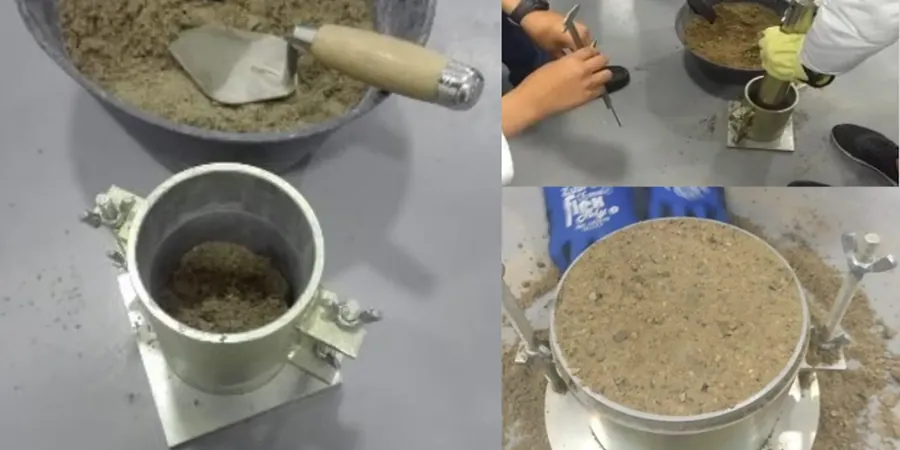
Critical ground factors in Palmerston North
A mistake we still see on Palmerston North sites is importing granular fill from a Horowhenua pit and compacting it to a target density borrowed from a completely different material's Proctor curve. Silty gravels, clay-bound sands, and clean river-run aggregate each peak at their own moisture and density combination, and using the wrong reference value makes field density testing meaningless. The consequence shows up as differential settlement under slabs, cracked kerb lines, or pavement rutting within two seasons. Another common failure is leaving the moisture conditioning to chance: Manawatu summers dry out stockpiles fast, and winter rain saturates them, so the Proctor's OMC target must guide active water adjustment at the fill face. Our lab provides the curve and the interpretation so that the roller operator and the site engineer are working from the same page.
Our services
Our Palmerston North lab handles the full compaction workflow, from sample receipt to field correlation, through these core service lines:
Standard Proctor (NZS 4402 Test 4.1)
For residential pads, landscaping fills, and lightly loaded commercial slabs where compaction effort matches smaller plant. We test silts, clays, and fine sands typical of the Manawatu floodplain.
Modified Proctor (NZS 4402 Test 4.2)
Applied to roading aggregate, heavy industrial yards, and airport pavements. The higher effort simulates modern vibratory rollers and heavily loaded haul routes around the city's logistics hubs.
Oversize Correction Testing
When fill contains gravel fragments larger than 19 mm we run the large mould variant and apply a rock correction factor, preventing overestimation of field density on stony Manawatu terrace materials.
Moisture-Density Curve Report Package
Includes full plotted curve, OMC and MDD values, zero air voids line, and a clear compaction specification recommendation for the site engineer and council consent documentation.
Frequently asked questions
How much does a Proctor test cost in Palmerston North?
A single-point Standard or Modified Proctor test in our Palmerston North lab typically runs between NZ$160 and NZ$340, depending on whether you need the full five-point curve or a rapid check against a known material. The price covers sample preparation, compaction, oven drying, and the formal report with the moisture-density plot. For multi-source fills where several curves are required, we provide bundled pricing.
Which Proctor method should I use for a residential driveway in Palmerston North?
For a typical residential driveway, Standard Proctor is usually adequate because the compaction plant is lighter and the structural demand is moderate. However if the driveway will carry heavy vehicles, such as a rural entrance off a metal road in the outskirts, Modified Proctor gives a more realistic target density. The final choice should match the specification in your building consent or the NZS 4404 earthworks section.
How much soil do you need for a Proctor test?
We need roughly 20 to 25 kg of representative material for a full five-point Proctor curve, more if the material contains oversize particles requiring the large mould. The sample should be bagged and sealed immediately after excavation to preserve its natural moisture, and delivered to our Palmerston North lab as soon as possible. If the fill source changes during the job, we recommend a new sample, because even slight variations in gradation can shift the compaction curve noticeably.