Palmerston North sits just 34 metres above sea level, perched on the deep alluvial and estuarine deposits of the Manawatu River floodplain. With a population exceeding 90,000, the city’s growth has pushed residential and commercial developments into areas where groundwater management becomes a decisive factor for foundation design and earthworks. The Lefranc and Lugeon in-situ permeability tests provide the direct hydraulic conductivity values that lab tests on disturbed samples simply cannot replicate. We run these packer and variable-head tests to quantify water flow through the Rangitikei sands, gravel lenses, and underlying soft mudstones that define Palmerston North’s subsurface profile. A reliable sondaje SPT campaign often precedes our packer work to identify the target horizons, while cimentaciones superficiales in the city’s Terrace End and Hokowhitu suburbs depend on accurate seepage data to avoid long-term buoyancy and softening of foundation soils.
A single Lugeon test in fractured mudstone provides more actionable data for cut-off wall design than a hundred remoulded lab permeameter samples.
Technical details of the service in Palmerston North
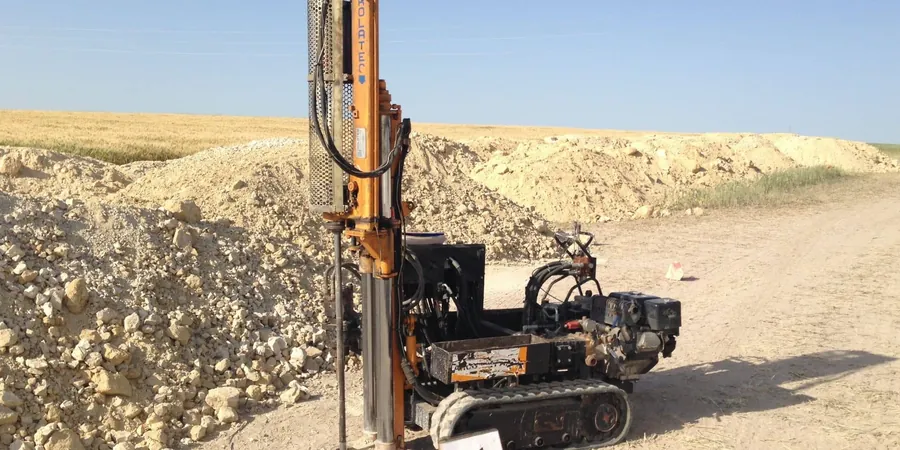
Critical ground factors in Palmerston North
The field setup involves a double-packer assembly lowered on AW or NW drill rods, connected to a calibrated flow meter and pressure gauge at the surface. We use a constant-head tank or a positive displacement pump depending on whether the formation is expected to accept high flows. In the granular deposits beneath Palmerston North’s industrial zones, the greatest risk during testing is hydraulic fracturing of the borehole wall if the packer pressure exceeds the overburden stress, creating artificial flow paths that invalidate the test. We mitigate this by maintaining packer inflation pressures just 100-150 kPa above the test pressure, as recommended in the Houlsby interpretation method. A more insidious failure mode arises from incomplete saturation of the test zone, which introduces compressible air pockets and yields K-values up to an order of magnitude too low; our technicians flush the interval thoroughly before each stage. Post-test, we run a ensayo CPT adjacent to the borehole to verify stratigraphic continuity and detect any unintended vertical leakage pathways.
Our services
Our Palmerston North field permeability programme integrates directly with the broader geotechnical investigation scope. The following services are typically contracted together to build a complete ground model:
Lefranc Testing in Soil
Variable-head and constant-head tests in granular and cohesive soils above the water table. We isolate each layer with a single packer to measure K-values for foundation drainage and retention design.
Lugeon Testing in Rock
Multi-stage pressure testing in the mudstone and sandstone bedrock. We follow the Houlsby (1976) interpretation to classify flow regime (laminar, turbulent, dilation, washout) and assign a representative Lugeon value.
Combined Permeability & Grouting Assessment
For dam curtain and cut-off wall projects, we perform pre- and post-grouting Lugeon tests to quantify the reduction in rock mass permeability and verify the grout curtain’s effectiveness against NZSOLD guidelines.
Frequently asked questions
What is the cost of a Lefranc or Lugeon test in Palmerston North?
A single Lefranc or Lugeon test interval typically ranges from NZ$1,170 to NZ$1,890, depending on borehole depth, number of pressure stages, and access conditions in the Manawatu. Mobilisation and drill rig standby are additional. We always confirm the fixed scope after reviewing the borehole logs.
When should I choose the Lugeon test over the Lefranc method?
Choose the Lugeon test when you are dealing with rock mass, even weak mudstone or sandstone. The Lugeon method uses multi-stage pressure increments to characterise fracture flow behaviour—laminar, turbulent, dilation, or washout—which a single-head Lefranc test in soil cannot capture. If your borehole log shows RQD above 10-20%, Lugeon is the correct tool.
How many test intervals do you recommend for a typical Palmerston North site?
We recommend one test interval per distinct geological unit identified during drilling. For a typical Manawatu profile with sand, gravel, and underlying mudstone, this means at least three intervals. For dam sites or where cut-off walls are planned, we test every 3 to 5 metres of depth along the entire borehole to capture vertical permeability variations.