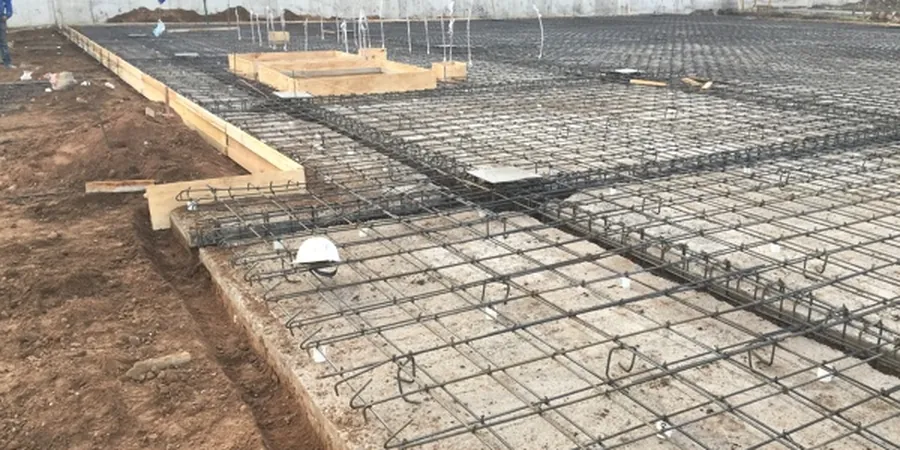
The soil profile changes dramatically within Palmerston North. A site near the Hokowhitu Lagoon often reveals soft peaty silts and a water table barely half a metre down. Move west toward the Terrace End loess and you hit firm, windblown silt with decent bearing. These contrasts explain why a standard isolated footing fails the differential settlement check on half the city's residential subdivisions. A raft foundation distributes structural load across the full footprint, bridging weak lenses that would otherwise require deep piles. We integrate in-situ testing—typically spt drilling to refusal depth and cpt testing for continuous tip resistance—before modelling the slab-soil interaction in PLAXIS 3D. The output is a reinforced mat that works with the ground, not against it. For the Manawatū floodplain, that approach stops cracks before they start.
A properly designed raft foundation in Palmerston North handles differential settlement across soft soil transitions without the cost of a full piled solution.
Technical details of the service in Palmerston North
Critical ground factors in Palmerston North
The geotechnical drill rig is the first piece of equipment on site, and in Palmerston North it's often a compact tracked CPT rig manoeuvring through a tight residential section. The cone pushes through the near-surface river silts at a steady 20 mm per second, measuring tip resistance and sleeve friction in real time. What it logs determines the raft foundation's fate. A sharp drop in tip resistance at 2.8 metres depth—classic loose sand layer—triggers a liquefaction check. If the factor of safety against surface manifestation drops below 1.3, the raft alone won't suffice. You either deepen the excavation and place a compacted gravel raft, or you switch to ground improvement. We've seen sites on Featherston Street where the difference between a standard raft and a remediated one was 80 cubic metres of imported fill and a full weekend of vibratory compaction. Skipping that step means differential settlement of 30 mm or more within the first five years. That's visible. That's expensive. That's why the CPT trace dictates the design, not the other way around.
Our services
Our raft foundation design package for Palmerston North projects covers the full geotechnical-to-structural chain. We don't just deliver a reinforcement drawing—we deliver the soil investigation report that justifies every bar size and spacing.
Integrated Geotechnical Investigation
CPT and SPT campaigns across the building footprint, groundwater monitoring, and laboratory classification of recovered samples to define the ground model for raft analysis.
Raft Structural Design and Detailing
Thickness optimisation, flexural and punching shear reinforcement schedules, and construction joint detailing compliant with NZS 3404 for all limit states.
Liquefaction and Settlement Analysis
Post-liquefaction bearing capacity assessment, reconsolidation settlement estimates, and ground improvement recommendations where the raft alone cannot meet performance criteria.
Frequently asked questions
When does a raft foundation make more sense than piles in Palmerston North?
When the site has a mix of soft and firm soils across the footprint, or when the liquefiable layer is deeper than 3 metres. Piles need to bypass the weak layer entirely, which can mean driving 15 metres or more. A raft spreads the load at shallow depth, often at half the cost. We run a comparative settlement analysis first—if differential movement stays under 15 mm with a raft, it's the preferred option.
How do you account for liquefaction in a raft foundation design?
We follow the NZGS/MBIE Module 4 framework. First, SPT or CPT data triggers a liquefaction susceptibility check. If the factor of safety is below 1.3, we calculate the post-liquefaction stiffness reduction and run a bearing capacity check with the degraded soil. The raft is then designed to span across softened zones, or we specify ground improvement—stone columns or compaction—before placing the raft.
What does raft foundation design cost for a residential project in Palmerston North?
For a standard single-storey residential slab, the geotechnical investigation and structural design package typically ranges from NZ$1,900 to NZ$7,450, depending on the number of CPT or SPT points needed and the complexity of the liquefaction analysis. Sites with poor ground requiring remediation design are at the upper end.
What soil investigation is required before designing a raft foundation here?
At minimum, two CPT soundings to 15–20 metres depth, one machine-drilled borehole with SPTs at 1.5-metre intervals, and laboratory classification of recovered samples. If the site is within the Manawatū River floodplain, we also install a standpipe piezometer to monitor groundwater level over at least one week. This data defines the ground model for the raft analysis.